95% of AI pilots return nothing — and the model is not the reason
The model already reads, summarizes and drafts better than you need. The pilot dies in month three because it never touched the process.
August 17, 2026 · F7 KORE · Applied AI · Manufacturing · Architecture
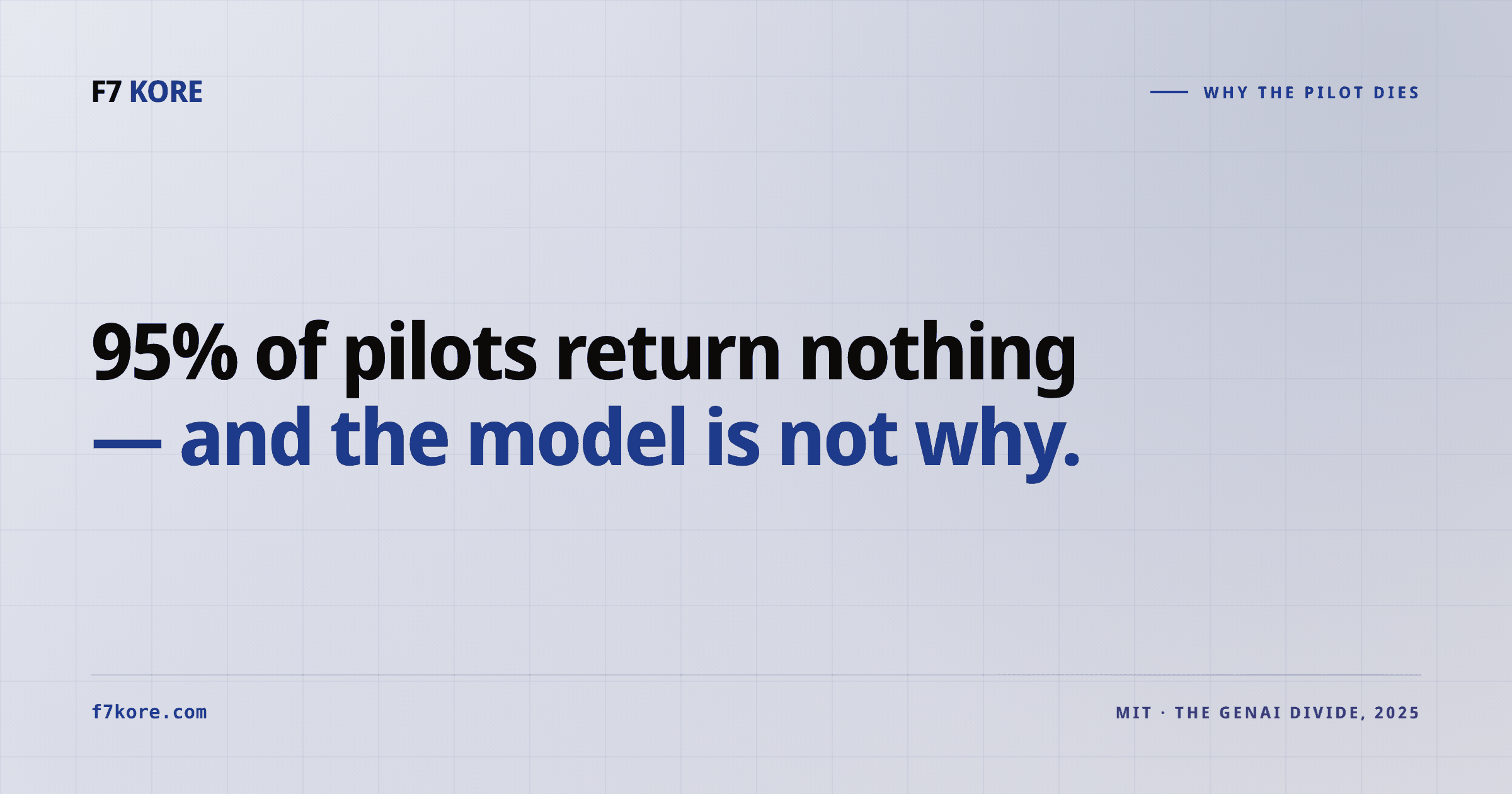
Ninety-five per cent of generative AI pilots delivered no return at all. The figure comes from MIT, in The GenAI Divide, 2025.
It is usually read as a verdict on the technology. That is the wrong reading, and an expensive one — because it leads to two equally bad conclusions: “AI does not work for manufacturing” or “we need a better model”.
Anyone who wants to argue with the study’s methodology is welcome to — the argument here does not depend on the figure being 95% or 70%. It depends on the reason not being the model.
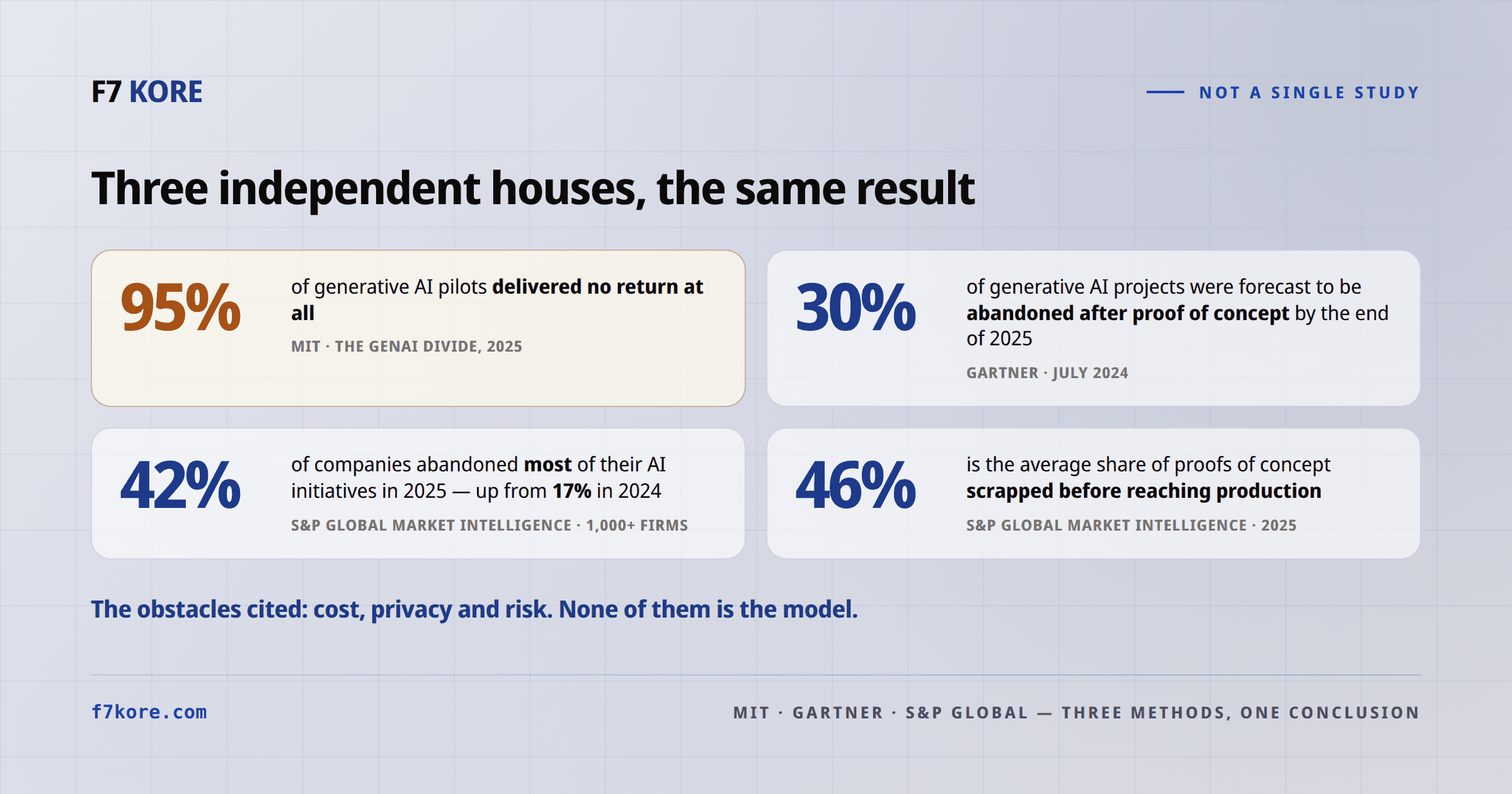
And it is not a single study. In July 2024 Gartner forecast that 30% of generative AI projects would be abandoned after proof of concept by the end of 2025. S&P Global Market Intelligence, surveying more than a thousand companies across North America and Europe, measured that 42% abandoned most of their AI initiatives in 2025 — up from 17% in 2024 — and that the average organization scrapped 46% of proofs of concept before they reached production.
Three different methods, three houses with no common interest, the same conclusion. And the obstacles companies cite — cost, privacy and risk — describe everything except the model.
The model is not the bottleneck. It has not been for a while.
What the model already does very well
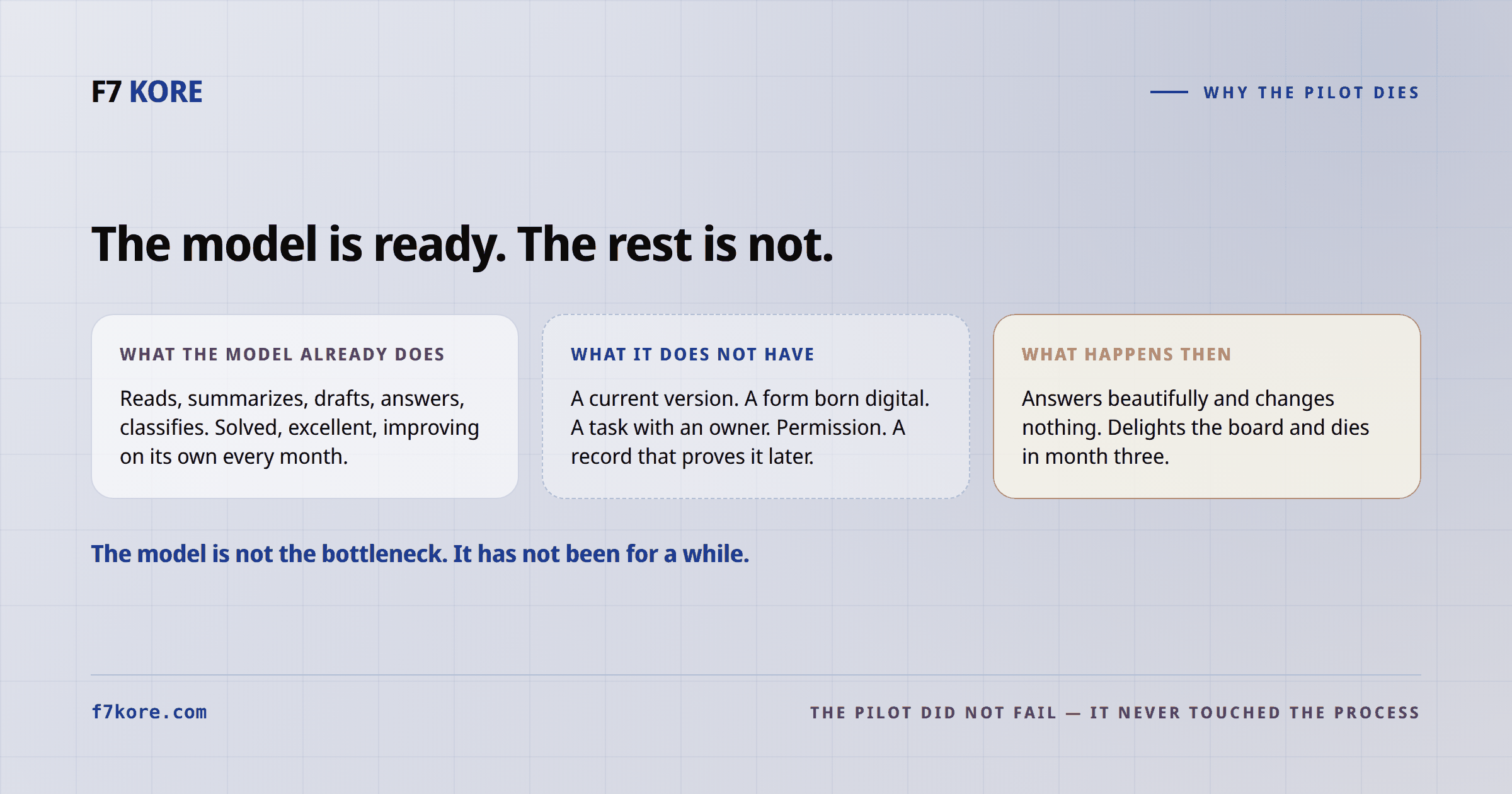
Reads, summarizes, drafts, answers, translates, classifies. That is solved, it is excellent, and it improves on its own every month without anyone at your company doing a thing. You will not gain competitive advantage in that layer, and you will not lose because of it either. It is public infrastructure, like electricity.
The pilot that dies does not die from model incompetence. It dies from something else.
What it does not have
Put an excellent model in front of your operation and list what it is missing in order to do real work:
- A document with a current version. Which of the four revisions of that procedure is valid today? The model does not know. It answers about whichever one you handed it.
- A form that is born digital at the workstation. The inspection exists on paper, was transcribed later, and half the fields came back blank.
- A task with an owner and a deadline. It spotted the nonconformity. Now who raises the action? By when?
- A permission that says who sees what. Can it show the cost sheet to the line operator? Can it read personal records? Nobody defined it.
- A record that proves it afterwards. The auditor asks why the decision was made that way. Where is it?
Nothing on that list is an artificial intelligence problem. It is all a foundation problem.
What happens then
Without those five things, the pilot follows a script anyone who has seen two of them recognizes from a distance:
It answers beautifully in the demo. It delights the board. It gets an internal name. It runs for six weeks on data someone prepared by hand. And it dies in month three — not because it was wrong, but because it never touched the process.
It never raised a corrective action. It never changed what the next shift does. It never reduced anyone’s rework. It stood outside the operation, answering well about it.
A pilot that answers well and changes nothing is not a pilot that narrowly failed. It is a pilot that was never in the game.
The foundation, in four pieces
What is missing has a name, and there are not many pieces. There are four, and the good news is that none of them is science fiction — they are things manufacturing already knows how to do with process, they just need to exist in a form the AI can use.
Permission. The AI sees exactly what the person who invoked it sees — not one document more. Without it you are stuck between two unworkable extremes: it reads everything (and trade secrets reach the intern), or it reads nothing (and it is useless).
Evidence. Every action with author, timestamp and version, in a record that cannot be altered. That is what turns an answer into proof — for the customer who audits you, the regulator who inspects you, and your own internal argument six months from now about why something was done that way.
Current version. One valid document, approved by whoever signs off, read and acknowledged by whoever executes. This is the quiet one: without it the AI answers perfectly about the wrong spec — and nobody notices, because the answer is flawless.
A path to write back. Raise the nonconformity, assign the owner, chase the deadline. Reading is the beginning. Acting inside the process is where the return finally appears — and it is precisely the step the average pilot has neither the permission nor the mechanism to take.
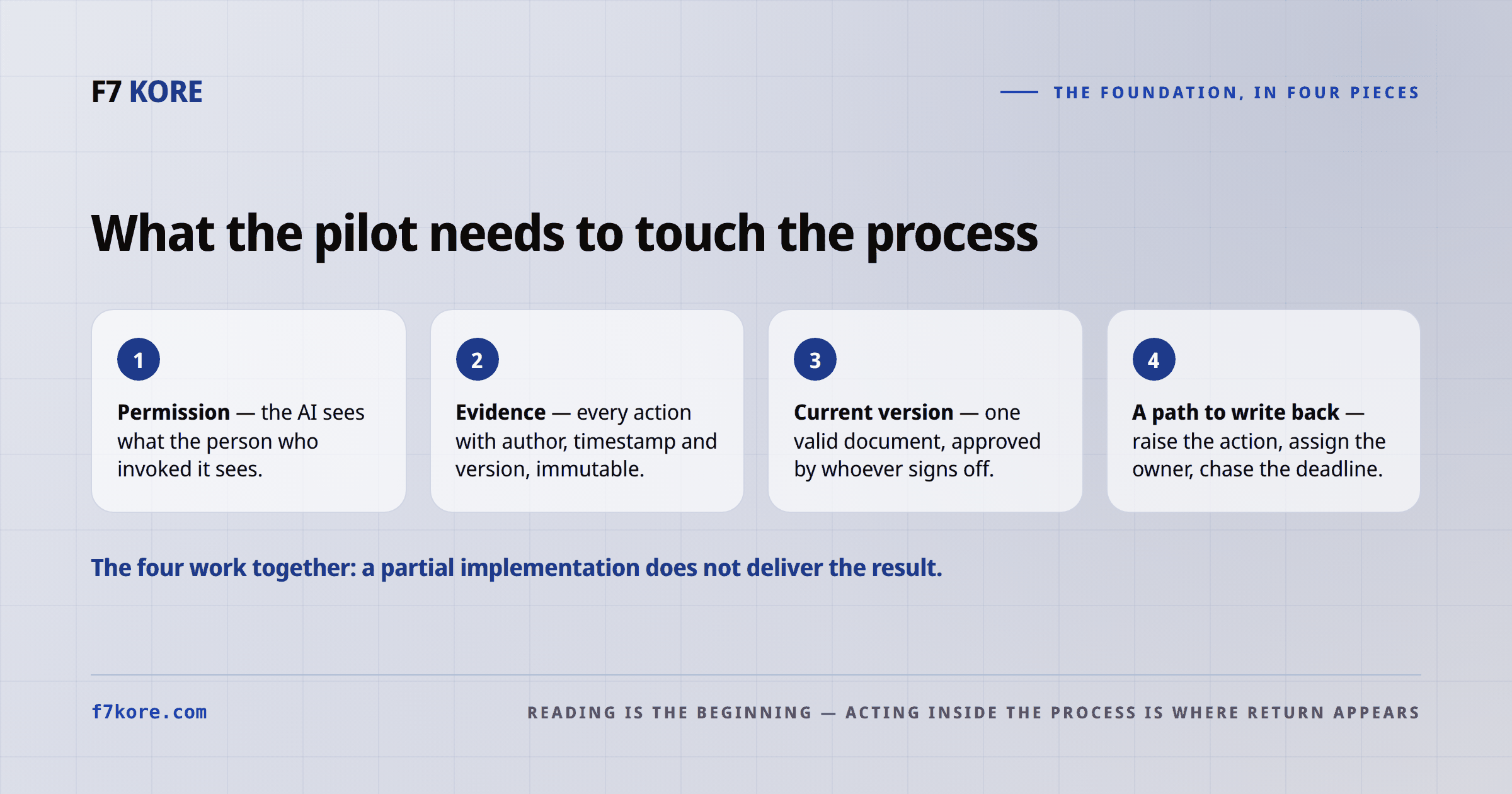
The four work together. Permission without a record proves nothing. A record without a current version proves the wrong thing. And none of the three changes the operation if the AI cannot write back into the process.
That kills the most common objection from teams already building internally: “I will add permission to my agent and be done”. A partial implementation of the four does not deliver the result — it delivers the feeling that it is handled.
What to do with the pilot you already have
If you have a pilot running and it is heading for the 95%, the symptom is easy to spot: it answers, and nothing happens after the answer.
The fix is rarely a different model. It usually comes down to four questions:
- Is it reading the current version of the document, or a copy someone uploaded?
- Does it see what the user sees, or everything, or almost nothing?
- Is there a record of what it did, with author and timestamp, in a place that cannot be altered afterwards?
- Can it write back — raise the task, assign it, chase the deadline — or does its output end on a screen?
If three of those answers are “no”, the pilot does not need more AI. It needs a foundation.
This is the third of four pieces on the same thesis. The other three: how AI came in through the boardroom, the new silo that talks back and where your spec sheet ended up.
The company behind F7 KORE has automated industrial processes for over a decade, in real operations and regulated environments.
If you have a pilot that answers well and changed nothing in the operation, the four questions above settle most cases in an afternoon. If you want to walk through them with someone alongside — talk to us.