The next silo in your plant talks back
The old silo was a spreadsheet sitting still. The new one answers with confidence — its own prompt, its own data, its own owner, and nobody versions or audits it.
August 17, 2026 · F7 KORE · Applied AI · Manufacturing · Governance
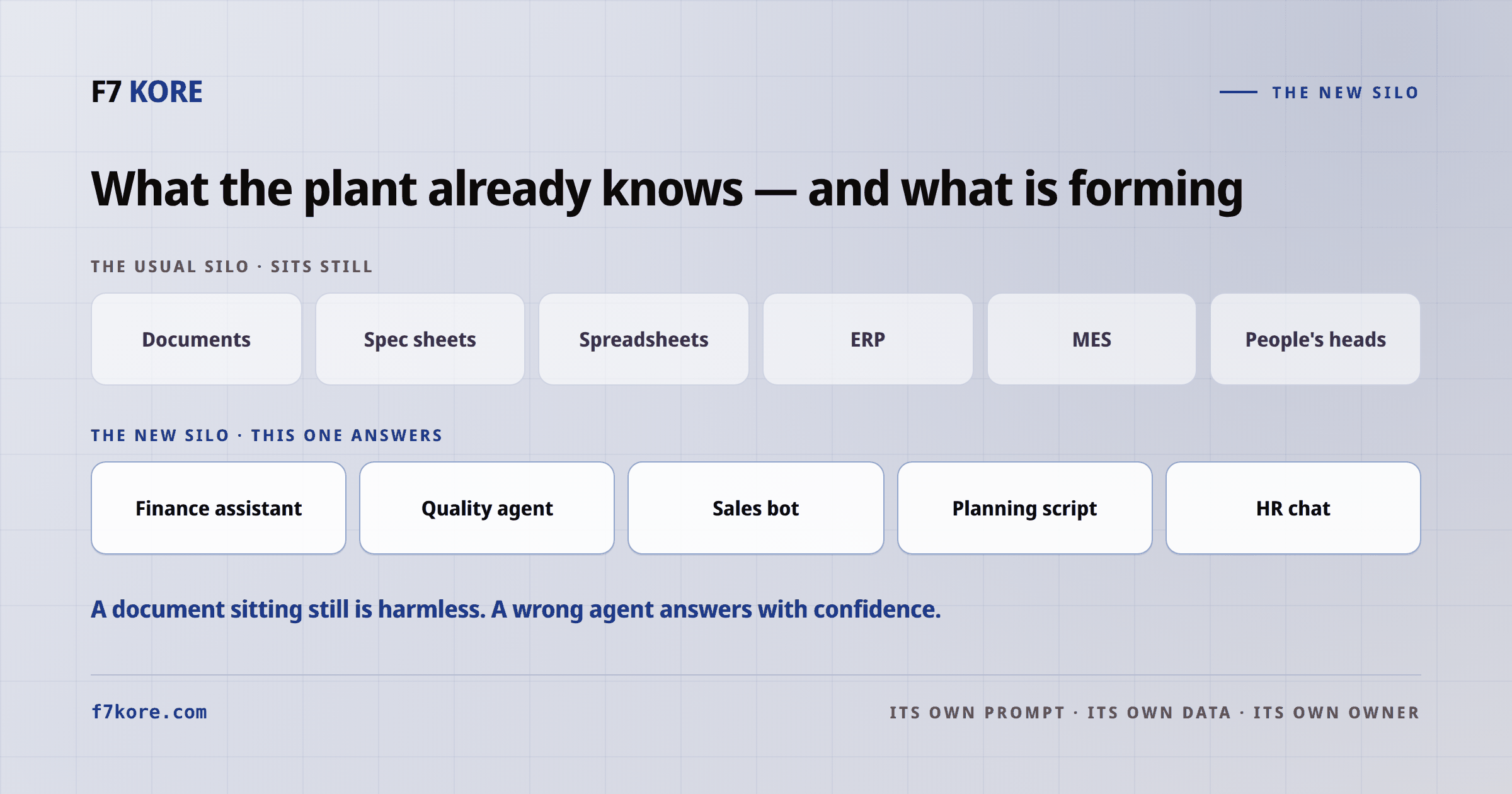
Silo is a word manufacturing knows by heart. Documents in one folder, spec sheets in another, spreadsheets on somebody’s laptop, the ERP holding one truth and the MES another, and the rest in people’s heads. Thirty years of integration projects were spent on exactly this.
A new silo is forming inside those same companies, and it differs from the old one in an uncomfortable way: the old silo sat still. The new one answers.
How it forms
Nobody decides to build a silo. It shows up like this:
Finance builds an assistant that reads invoices and reconciles them. Quality builds an agent that compares lab reports against specification. Sales has a bot answering catalogue questions. Production planning has a script that reshuffles the schedule. HR has a chat that answers internal policy.
Every one of those was born good. Built by someone who understands the process, solving a real problem, saving expensive people’s time every day. That is not a defect — it is evidence that there are capable people inside who did not wait for permission to fix something.
The defect is not in any one of them. It is in the set.
Its own prompt, its own data, its own owner
Each of those solutions carries three things that do not talk to the others:
- Its own prompt. The business rule lives inside text someone typed. It exists in no document, went through no approval, and nobody else knows it is there.
- Its own data. Each person uploaded what they needed — their department’s spreadsheet, the PDF they downloaded, whichever revision of the procedure they happened to have that day.
- Its own owner. One person maintains it, one person understands it, one person fixes it. When they go on holiday the assistant keeps answering — only now nobody can correct it if it gets something wrong.
And most importantly: nobody versions it and nobody audits it.
This is where the new silo gets worse than the old one. Knowledge that was scattered across documents is now also scattered across prompts. But a document sitting still is harmless — if it is out of date someone notices, or at least nobody trusts it automatically. A wrong agent answers with confidence, instantly, wearing the same face as a right one.
The eighteen-month test
Run the exercise against your own company. A year and a half from now:
- How many internal assistants exist?
- Which of them reflects the current procedure, and which froze a 2026 revision?
- Who approved the rule written inside each one?
- If two of them answer differently about the same process, which is right?
- When the auditor asks why a decision was made that way, where is the record?
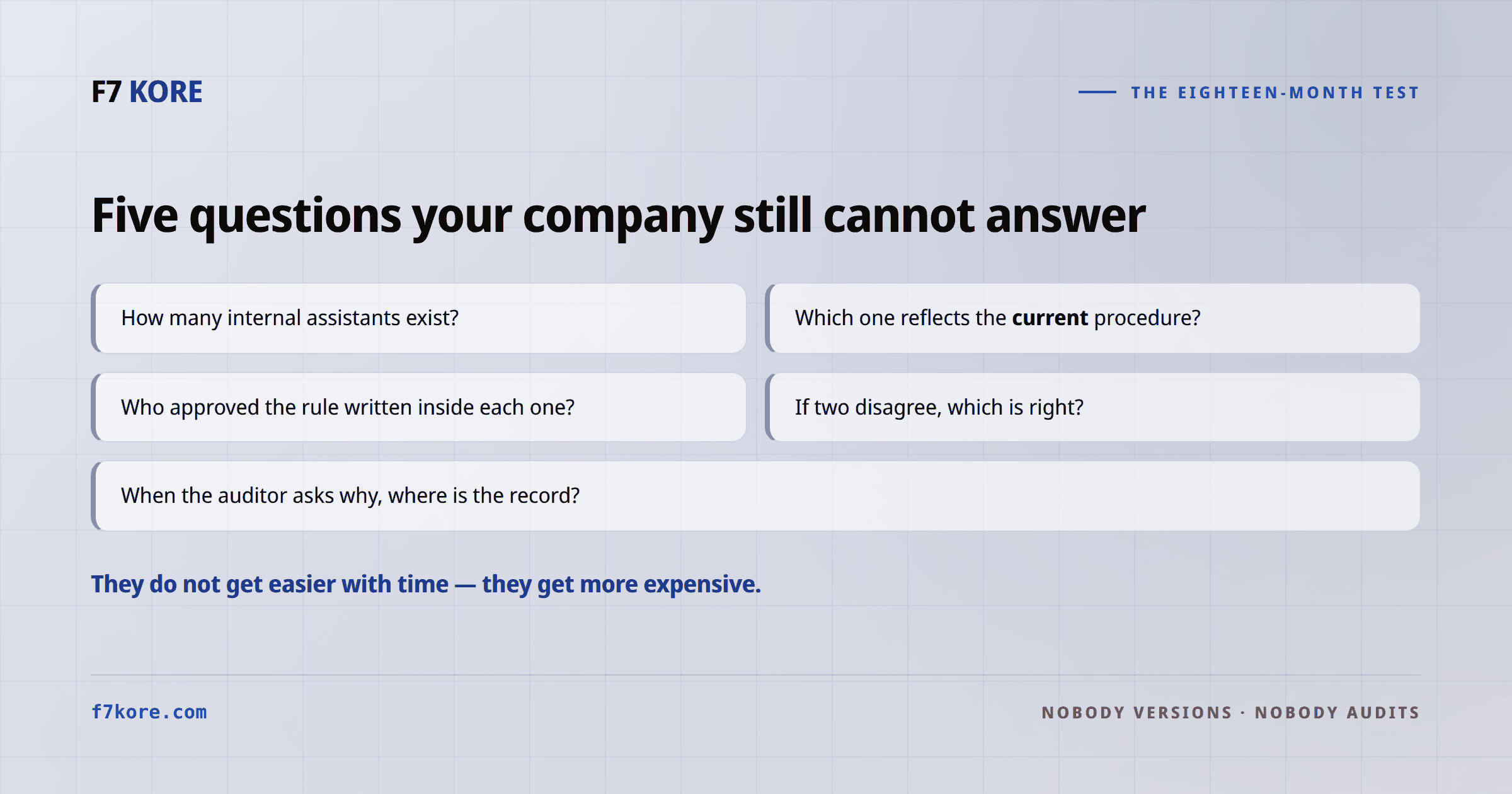
None of those questions has an answer today in most companies. And they do not get easier with time — they get more expensive, because by then the operation depends on the thing.
What happens to those agents — what has already been measured
Three independent measurements describe the fate of what is being built right now.
Most will not survive. Over 40% of agentic AI projects will be canceled by the end of 2027, due to escalating costs, unclear business value or inadequate risk controls (Gartner, June 2025). The three reasons have something in common: none of them is the quality of the agent.
The category is noisy. Among the thousands of vendors claiming to be agentic, Gartner estimates only about 130 actually are — the rest is rebranded assistants, RPA and chatbots, a practice the firm calls agent washing. If telling them apart is hard in the market, it is exactly as hard among the five assistants born inside your company.
And nearly half of usage is still unsupervised. 47% of generative AI users work through a personal account their company does not track (Netskope, Cloud and Threat Report 2026, measured in real traffic between October 2024 and October 2025). The good news from the same report: use through a company-approved account jumped from 25% to 62% in a year. Governance started — the other half stayed where it was.
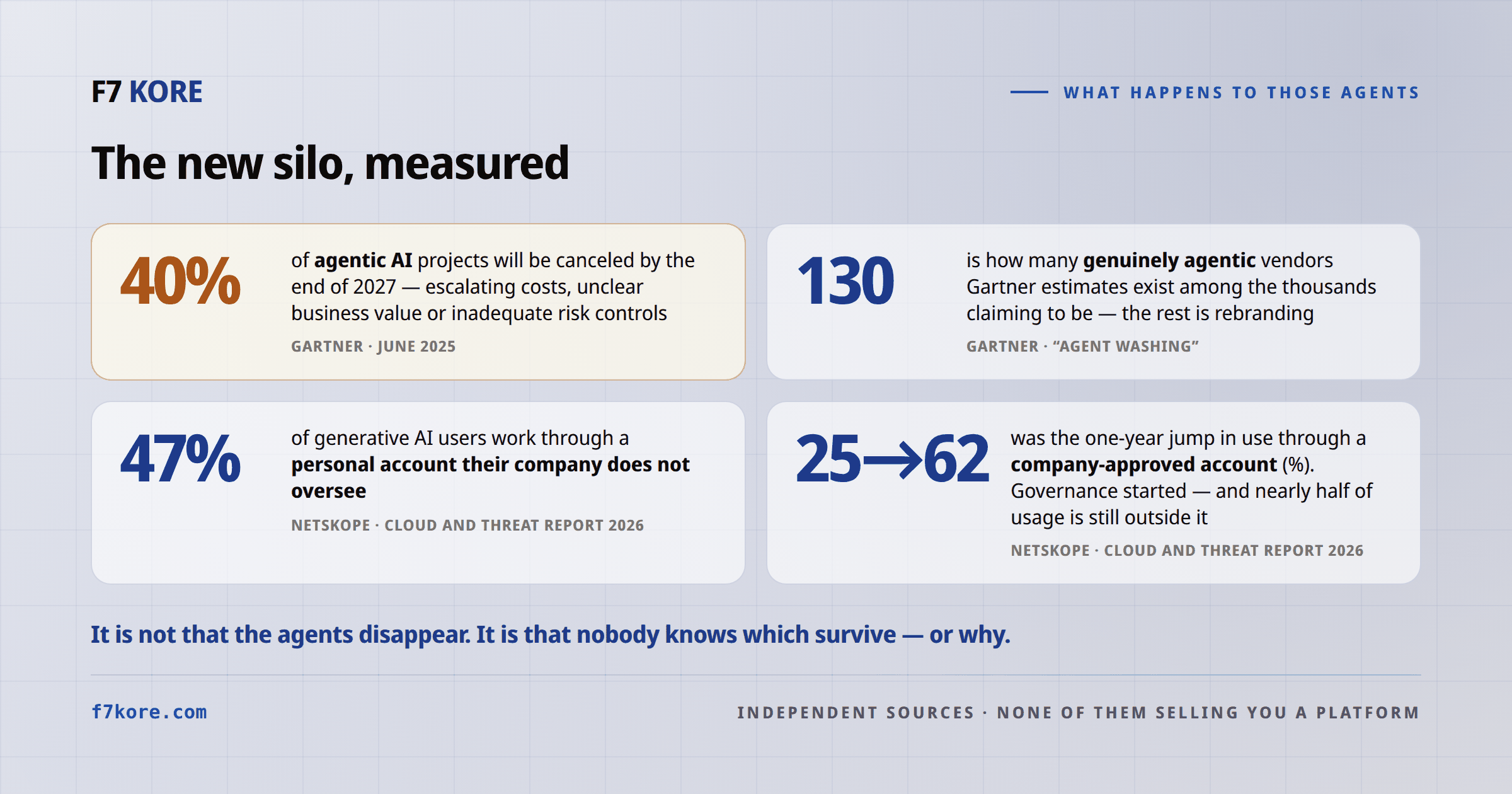
So the problem is not that internal agents will disappear. It is that nobody will know which ones survived, or why — and that is precisely the question the auditor asks.
”So what happens to what my team already built?”
That is the question that matters, and it deserves a straight answer rather than a slogan.
We assess them one by one.
Whatever solves something real, we integrate: that assistant starts reading the document in its current version instead of a PDF somebody downloaded, and writing into the same record the rest of the operation uses, within the permission of whoever invoked it. It does not die — it gains a foundation.
Whatever was a workaround for a problem the platform already solves stops needing to exist. Not because it was badly built, but because it was built to compensate for an absence that is no longer there.
And there is a third effect, usually the most valuable: the inventory of what your team built is the best list of pain points in the company. Nobody spends a weekend building a script for fun. Each of those assistants is a marker planted on a spot where the process hurts. That list took months to produce and is written down nowhere — it is where to start.
What separates an assistant from an operation
The difference between “we have five assistants” and “AI works in our operation” is not model quality. It is what exists underneath: permission, evidence, current version and a path to write back — the four pieces missing from 95% of AI pilots.
They cannot be solved one at a time, which is why the answer is not “each department should look after its assistant more carefully”. Individual care does not produce a single version, and no amount of goodwill produces an immutable record.
Whoever owns this gains, not loses
Consolidating assistants onto a common foundation does not take work away from whoever owns AI in the company — it takes away the work nobody sees. Anyone who has maintained five integrations built by five different people knows exactly which part of the week disappears. That part.
This is the second of four pieces on the same thesis. The other three: how AI came in through the boardroom, why 95% of pilots return nothing and where your spec sheet ended up.
The company behind F7 KORE has automated industrial processes for over a decade, in real operations and regulated environments.
If your company already has internal assistants running, bring the list. The conversation starts there, not with a product demo. Talk to us.