AI came in through the boardroom, not through IT
It is the first industrial technology that never waited for a project, a consultancy or an IT budget — which is why it arrived with no company decision behind it.
August 17, 2026 · F7 KORE · Applied AI · Manufacturing · Governance
Every industrial technology of the past three decades came in through the same door. Someone identified a need, built a project, requested budget, hired a vendor, integrated, trained. ERP, MES, WMS, PLC, shop-floor data collection — all of them. It took months, sometimes years, and IT was in the room from the first meeting.
Generative AI did none of that. It came in through the person.
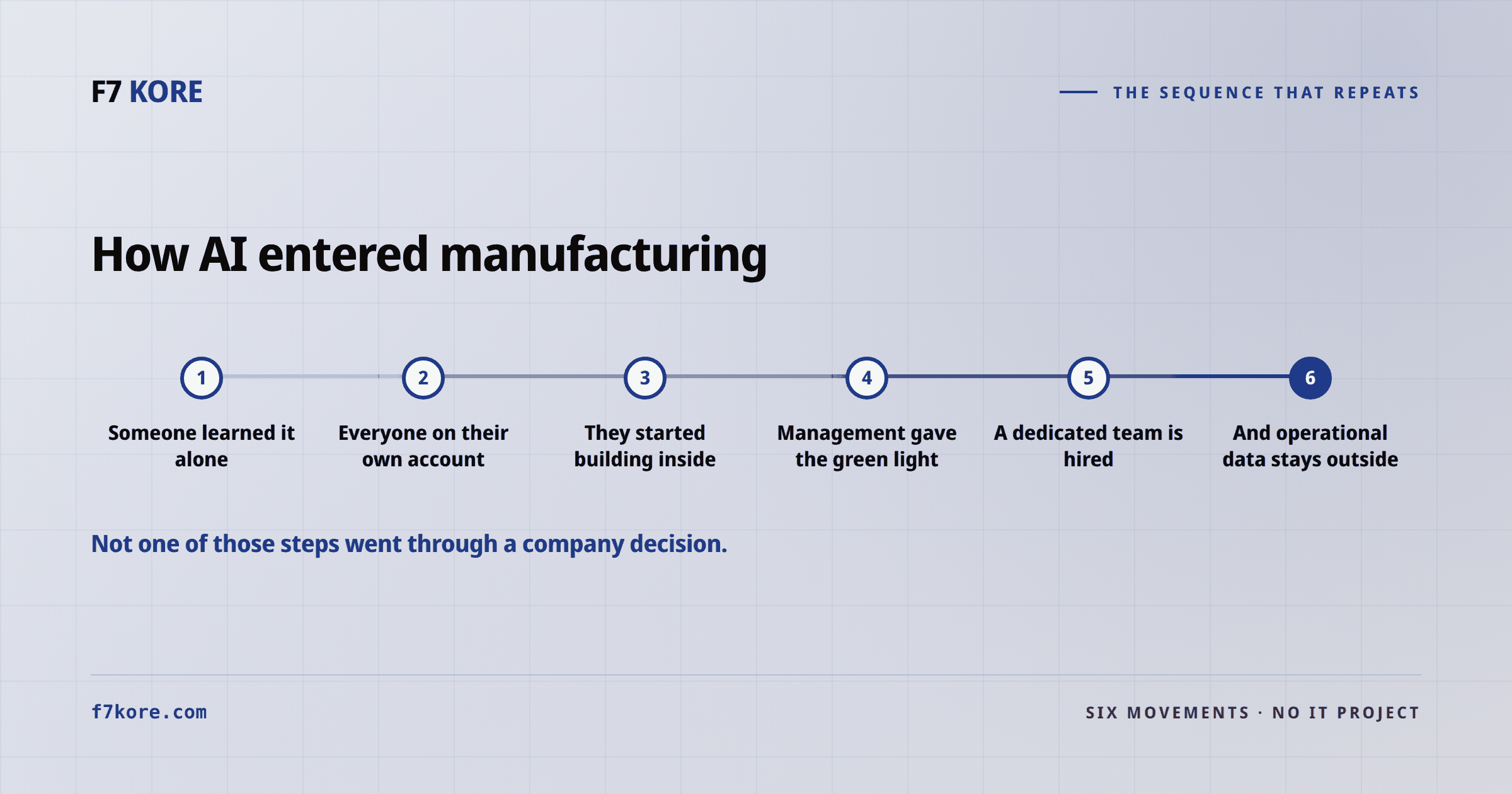
The six movements
Mark the ones you recognize. The order matters more than the count — where your company sits in the sequence defines what to do next.
1. Someone learned it alone. Executives, engineering, back office — they took a course on their own, on a weekend, without asking anyone. No project, no consultancy, no line in the IT budget.
2. Everyone on their own account. One person uses one tool, another uses a different one. Personal login, personal plan, personal card. The company never chose an AI vendor — individuals did, one at a time, by preference.
3. They started building inside. A script here, an assistant there, a custom agent. Small, useful, and almost always built by someone who understands the process rather than software.
4. Management gave it the green light. What had been quiet individual use became sanctioned practice. And nothing was defined about what may or may not be uploaded.
5. A dedicated team is being hired. A named role to own AI internally. For the first time there is budget and a head assigned to the topic.
6. And operational data is still outside. Spec sheets, inspections, formulations, shift reports, work orders: still in spreadsheets and loose documents. Whatever the ERP never captured, nobody captured — and that is precisely where the real operation happens.
If you recognized three or four of those in your own company, that is the correct reading. It is not a sign of disorder; it is what happens when a technology becomes good and cheap before any department has had time to decide what to do with it.
Not an impression — what the numbers show
This reading is easy to dismiss as opinion. It is not, and four numbers from independent sources are worth looking at.
Entry through the person is measured. 78% of people using AI at work bring their own tool, and at small and mid-sized companies that rises to 80% (Microsoft · LinkedIn Work Trend Index). This is not an informal minority: it is the default mode of adoption.
So is the absence of a decision. 60% of leaders say their own organization lacks a plan and a vision for AI — same source. The people inside know the decision was never made, and say so about themselves.
And the exposure is not carelessness. This is the number that surprises anyone who assumes the problem is sloppiness: 64% worry about leaking sensitive information to the outside or to a competitor — and nearly half admit to having uploaded non-public company data to an AI tool anyway (Cisco · Data Privacy Benchmark Study 2025).
Look at what that combination means. It is not that nobody cares. The concern exists, it is the majority position, and it does not change behavior — because the person has something due today and the tool solves it. Training and policy do not win that contest. Only a working alternative does.
And in the end it does not pay. 95% of generative AI pilots delivered no return at all (MIT · The GenAI Divide, 2025). Very high adoption, by capable people, with a technology that works — and almost nothing at the other end.
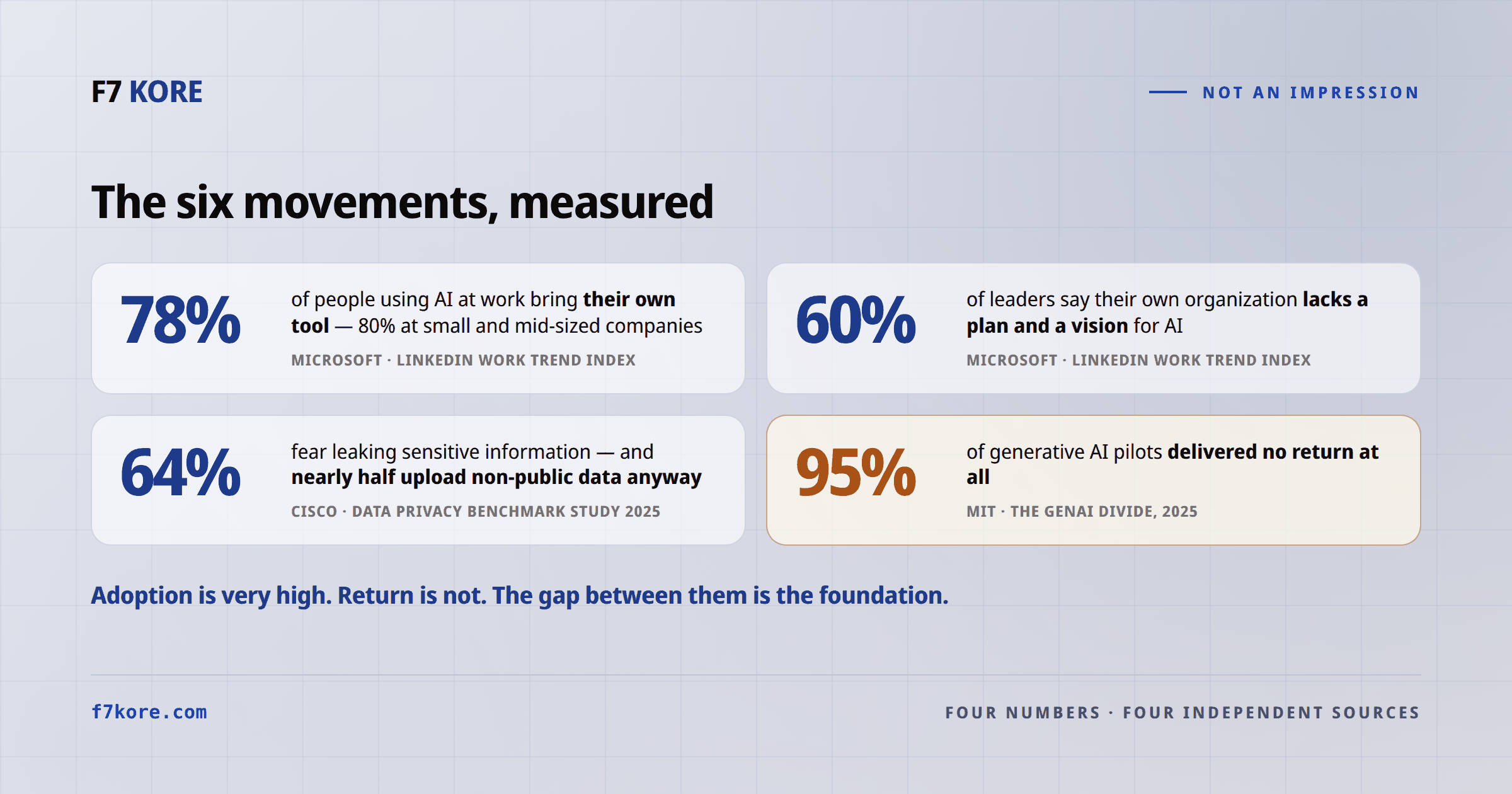
Those four numbers are not four problems. They are one, seen from four angles — and its cause is not the model.
What that entry door produces
Coming in through the person has a consequence that only surfaces later, and it is not about technology.
When ERP arrived, the company negotiated a contract, defined who administers it, decided where the data lives, established who has access to what. It was slow and bureaucratic — and at the end there was a company decision.
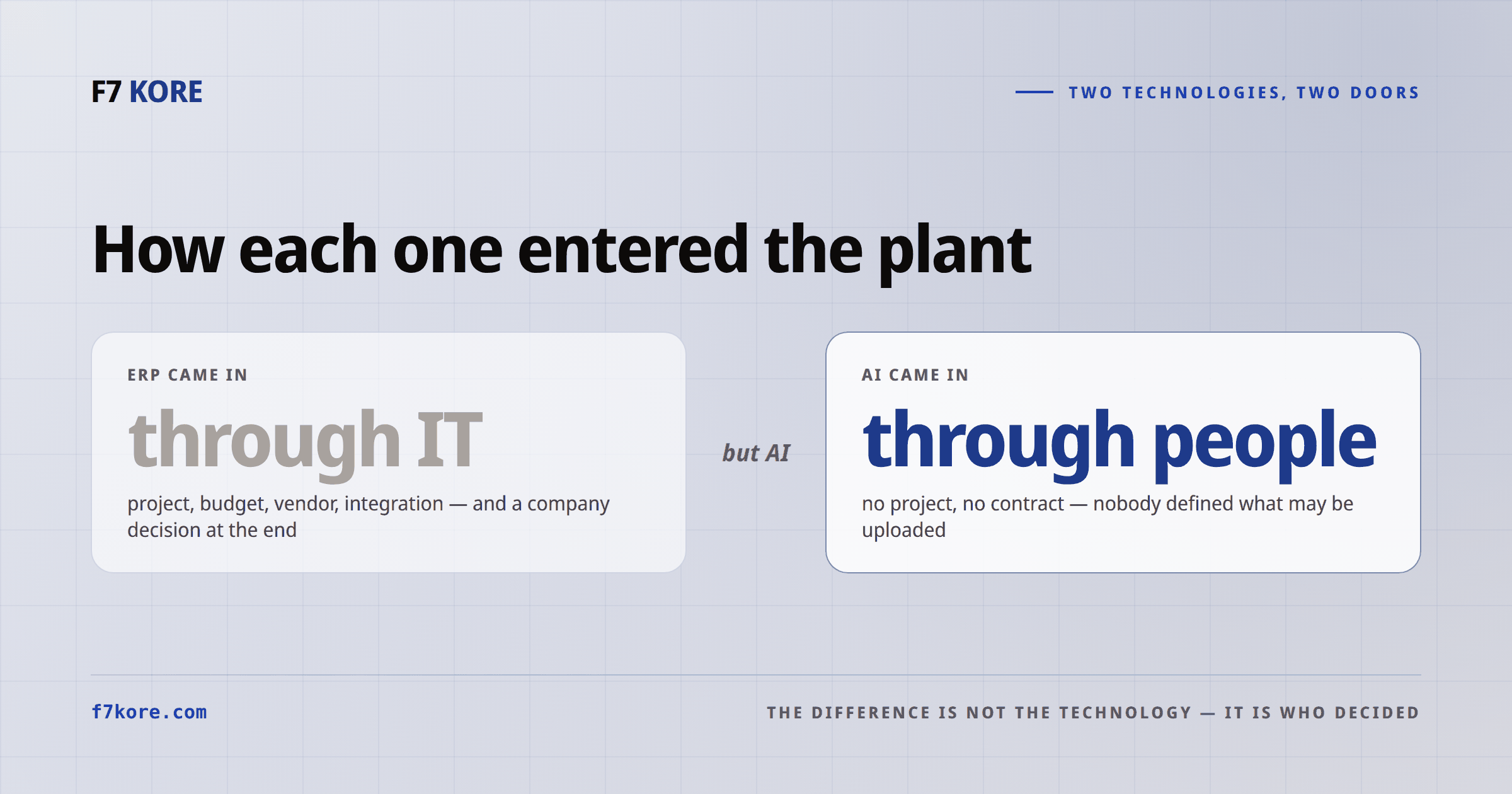
With AI, none of that happened. The result is that in most mid-sized manufacturers today there is no answer to some very simple questions:
- Which AI tool does the company use? Depends who you ask.
- Where is the history of what has been built with it? In each person’s own account.
- What company information has been uploaded? Nobody knows.
- Who approves a new agent before it starts answering for others? Nobody.
- If the person who built it leaves next week, what remains? The file, maybe. The context, no.
None of these questions is an accusation. All of them are the ordinary price of bottom-up adoption — and it is exactly that price that comes due the moment a company decides to take the topic seriously.
The most expensive misreading
Faced with this picture, the instinct is usually one of two: clamp down or wave it off.
Clamping down means blocking tools, publishing a usage policy, requiring prior approval. It fails for a practical reason: the tool is on the person’s phone, it works, and it solved a real problem for them last week. Banning it pushes usage into the dark — which is where it gets more dangerous, not less.
Waving it off means treating it as a passing fashion. That fails too: movement 5 has already happened. Budget was allocated and someone was hired. That does not reverse.
The third reading is the useful one, and it is far less dramatic: AI came in through the right door — the person who has the problem — and arrived without the foundation a company needs underneath it. This is not a discipline problem. It is missing infrastructure.
What the foundation is
The foundation is not an AI tool. It is what has to exist underneath so that any AI — the one already in use, the one your team built, the one arriving next year — can work across the whole operation at once without becoming a liability:
- Permission. The AI sees exactly what the person who invoked it sees — not one document more. Without it, either it reads everything or it reads nothing. Both are unworkable.
- Evidence. Every action with author, timestamp and version, in a record that cannot be altered. That is what turns an answer into proof — for the customer who audits you and the regulator who inspects you.
- Current version. One valid document, approved by whoever signs off, read and acknowledged by whoever executes. Without it the AI answers perfectly about the wrong spec, and nobody notices.
- A path to write back. Raise the nonconformity, assign the owner, chase the deadline. Reading is the beginning; acting inside the process is where the return shows up.
None of them works alone — the four only deliver together.
What changes for the person hired to own this
A ready foundation does not reduce the work of whoever owns AI in your company — it changes the work.
Building permission, immutable trails, version control and a write path is what consumes years of any internal build. It is platform work, not operations work. When that layer comes ready, whoever owns AI inside stops building foundation and starts building what only your plant knows — your industry’s rule, your process’s criterion, the exception that exists only on your line.
That is the part no vendor delivers, because it is not transferable. And it is the part that is worth something.
Where to start
Not with the whole platform. With one pain:
- Pick one pain — the one that hurts now, not the full map.
- Upload what already exists — your documents, spec sheets and spreadsheets, with no data project.
- Run it with a small team — one area, one shift, on real operational data.
- Measure and decide — in weeks you see whether it became routine. Then it grows module by module.
And there is a shortcut almost nobody uses: the inventory of what your team already built on its own is the best list of pain points in the company. Nobody builds those scripts for fun — each one marks a place where the process hurts enough that someone spent a weekend fixing it. That list is where to start.
This is the first of four pieces on the same thesis. The other three: the new silo that talks back, why 95% of pilots return nothing and where your spec sheet ended up.
The company behind F7 KORE has automated industrial processes for over a decade, in real operations and regulated environments.
If your plant sits somewhere in those six movements, the first step is not choosing a platform — it is taking inventory of what your team already built. If you want to do that inventory with someone alongside, talk to us.