Four systems, one customer: how F7 KORE integrates what your company already runs
One record per customer, built from the best piece of each system, with every field saying where it came from. That is how F7 KORE integrates your ERP, CRM and the rest without replacing anything that works — and without letting the integration stop in silence.
September 25, 2026 · F7 KORE · Integration · Industry · Data
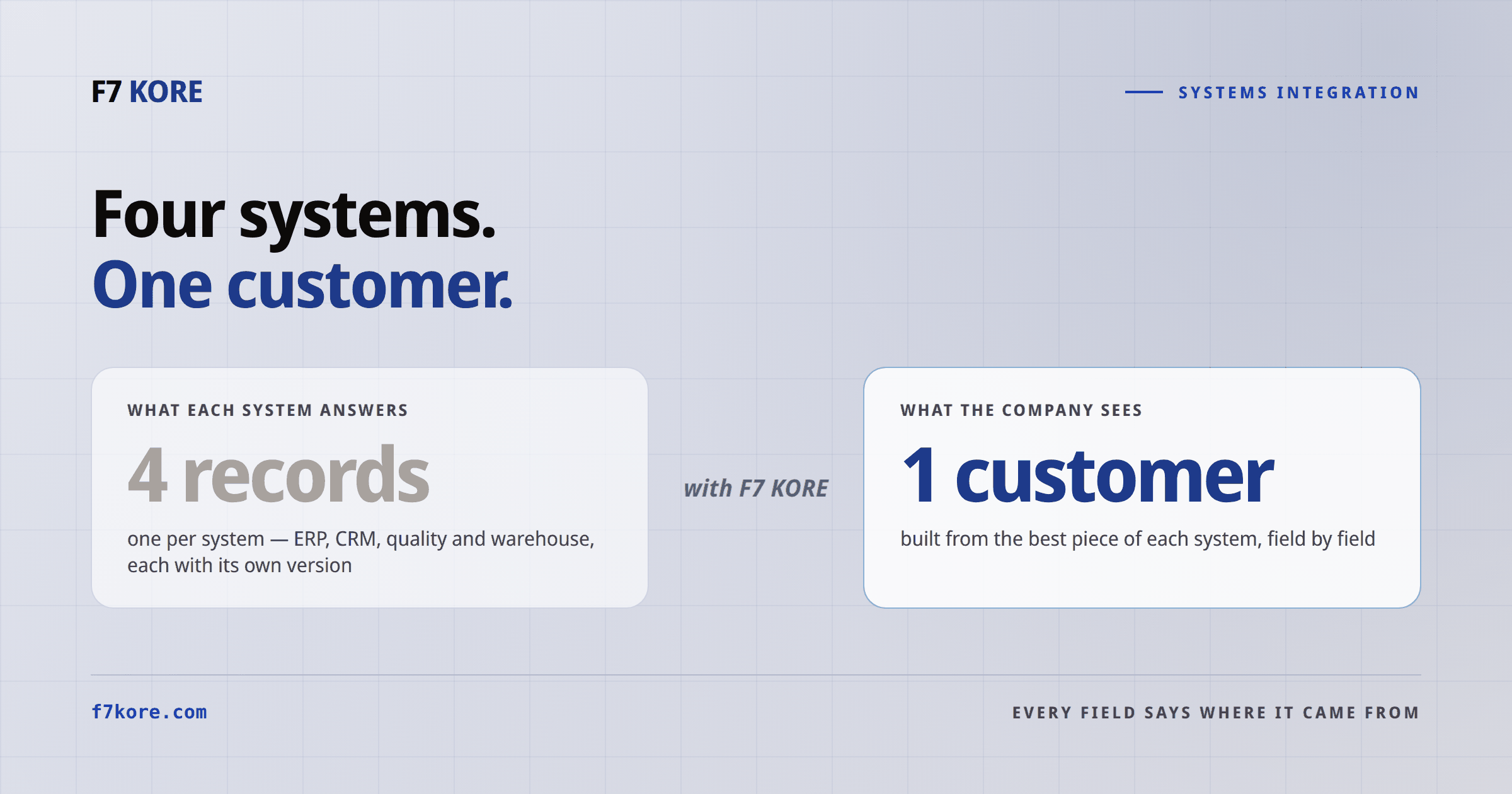
Everyone has bought systems integration at least once: the ERP talking to the CRM, the CRM talking to the quality system, a connector here, a nightly load there. It works on the day it goes live. What nobody buys, and what is missing, is the answer to the simplest question you can ask about a customer: how many are there?
F7 KORE does not wire system to system. It makes a single customer exist — and keeps, field by field, where every value came from.
The problem, the way it really shows up
Sales registered the company in the CRM under its trade name. Finance registered it in the ERP under the legal name and tax ID. The lab opened a record in the quality system with an internal code. The warehouse registered it again, with the shipping code. None of the four got it wrong: each recorded what it needed to do its job.
They are the same company, and no system can know that on its own. The consequence is not cosmetic. The revenue-by-customer report counts four. The campaign sends four e-mails. The credit analysis looks at a quarter of the history and approves a limit it should not. The salesperson calls someone who is already a customer. Someone types everything in again.
The usual attempts are well known, and they all stop at the same place. Standardizing records by hand lasts until the next day. Electing one system as the owner throws away what only the others have — the ERP has the tax ID and the billing address, the CRM has the contact who picks up the phone. Wiring everything to everything turns six systems into fifteen links, each with its own rule for who wins, and when one breaks nobody knows which. A report that joins on the fly answers once and leaves nothing standing.
What your company gets
Four things, and they hold each other up.
One record per customer, per product, per batch. Built from every system that talks about it, with the best piece of each. That record is what the screens, the reports and the forms read. Connecting the fifth system changes nothing for the reader: one more source is born, and the record is still one.
The decision of who is who, with criteria. What decides whether two records are the same thing is a scoring rule, calibrated per record type. It adds points when fields agree, subtracts when they disagree, and the result lands in one of three bands: merges on its own, goes to a review queue, or they are different records.
The origin of every value, on screen. For each field of the unified record, F7 KORE shows which system provided it, when, and what the other candidates were. It is not a hidden technical log: whoever opens a customer’s record sees, next to the legal name, where that legal name came from — and, when systems disagree, sees both.
An on-call panel. Integration is not a project that ends; it is something that runs every day and one day stops. The panel shows, per record type and per system, what came in, what was rejected, how long since the last load arrived and what is stuck right now.
How the pieces fit
Three pieces and two conversations. F7 KORE, where the unified record, the scoring rule and the panel live. An integration environment, one per company, that speaks the language of your systems and returns the data ready. And your systems — ERP, CRM, quality, warehouse — which stay exactly as they are.
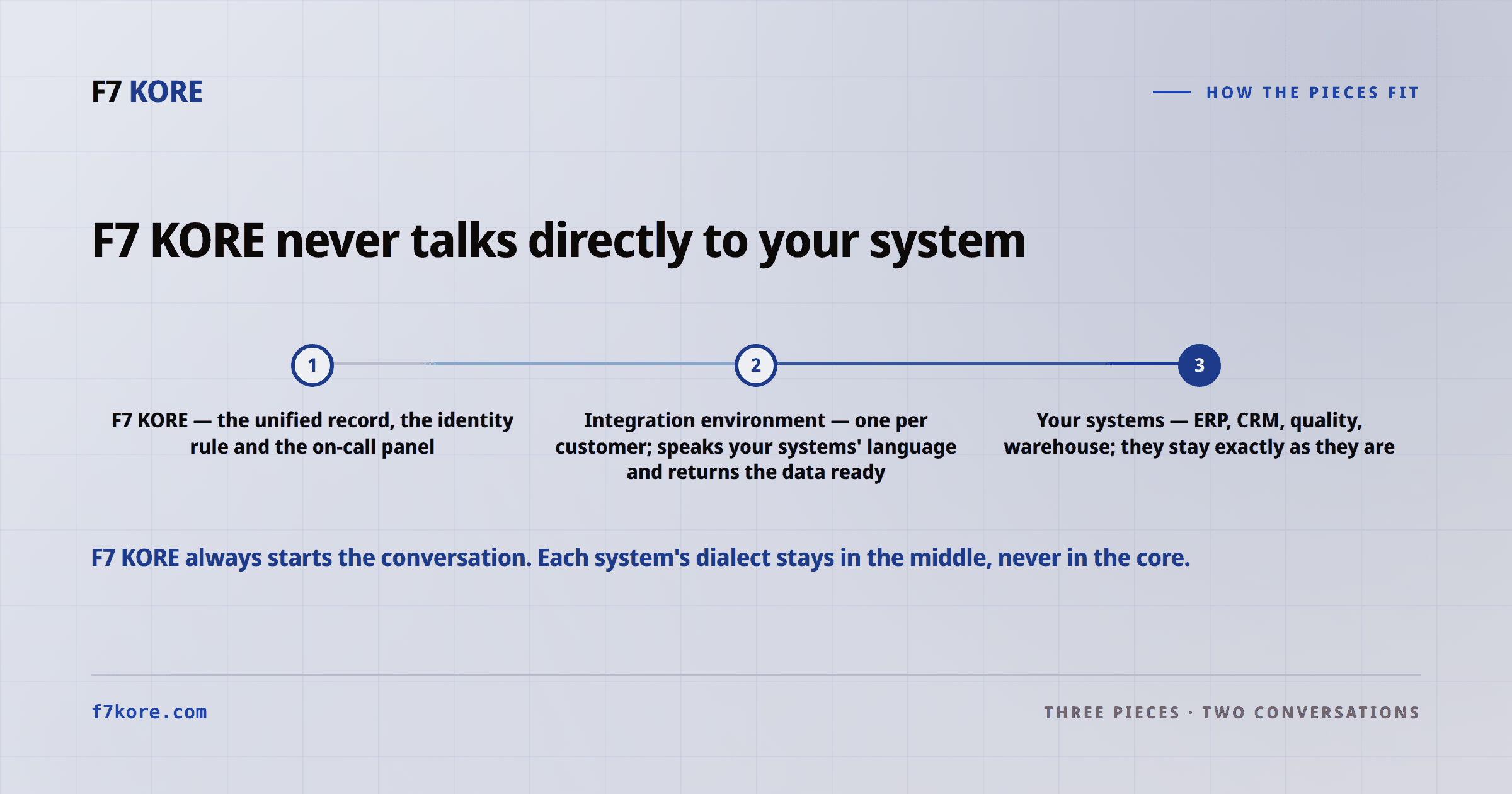
The rule that organizes everything: F7 KORE never talks directly to your system. It talks to the integration environment, and it is always the one that starts the conversation. That middle layer absorbs the hard part of any integration, which is not the data: it is the dialect. Every system has its own way of handing over data in batches, its own date format, its own response rhythm, its own way of saying a record was deleted. In the ERP, “customer” may be called “partner”, and “partner” may be customer and supplier at the same time. None of that enters the core of the product: from the inside, every system looks the same.
Three consequences that matter to a buyer:
- One environment per company is not a naming convention: it is what keeps your company’s data from crossing into another’s.
- The same design in the cloud and on your premises. The environment can run on Google Cloud in São Paulo or on-premises, in your company’s infrastructure. The conversations are the same; you move from one to the other without touching the core.
- No password ever goes through a screen. The credential F7 KORE uses to call the environment lives in a vault; the configuration only shows its alias.
The rule that decides who is who
Anyone who has seen a master data tool will recognize the rule: it is what separates a serious integration from a naive comparison. The difference is where it lives — not in one more system you buy, integrate and operate, but inside the platform where the record, the task and the form already read the data.
Every pair of records gets a score: it adds the weight of every field that agrees and subtracts the weight of every field that disagrees. Without the “Ltd.”, without the “Inc.”, without capitals and accents, two legal names written differently become the same text and add points — the normalization is declared once, in the record type’s profile, and applies to every system.
Disagreement subtracts because two tax IDs, both present and different, are evidence against the records being the same, even with nearly identical names. A rule that only added would merge headquarters and branch every time: same name, same city, same phone, different documents. And absence is not disagreement: an empty field on one side does not subtract, it simply does not add. Without that distinction, every incomplete record — which is most of them — would sink in the score and never match anything.
Pairs that land in the middle band go to a queue, and the decision is made by a person in your company, looking at each system’s version side by side and at what the system compared: in favor, every field that agreed and how many points it added; against, every field that disagreed and how many it took. The data does not sit locked waiting: the record comes in and takes its place in the unified record; it is the pair that waits. When someone confirms, the two merge. When someone denies, the pair never comes back to bother anyone. And, for each pair, the platform’s AI writes in one line why the two look like the same company — “same e-mail domain; the documents differ because one is a branch” — so that the decision fits whoever knows the business, not whoever knows databases.
Why integration is our job
Because an integration that goes wrong rarely breaks. It stops in silence. And F7 KORE was designed, decision by decision, so that this does not happen — in the part that is its own, and in the contract it imposes on whoever connects the system on the other side.
The “read up to here” marker only moves after the data has been accepted. If it advanced before, a lost page would not come back in the next window, and nobody would know it was gone.
Deletion arrives marked, never as absence. The contract requires that a record deleted in your system arrives saying it was deleted; F7 KORE keeps the last known value, which is what explains what disappeared.
The connection test checks what matters. It is not enough for the environment to answer: it has to declare that it serves the record type that was configured. Without that, the integration stays green and brings nothing, sometimes for weeks.
An error is an error, with the reason named. The contract forbids the answer that says “it worked” with an error hidden inside — the most efficient way for a failure to go weeks unnoticed.
On the way out, the contract requires your system to return the identifier of the record it created. That is what keeps the next delivery from creating the record again. And F7 watches, in the console, records created and records updated as two separate numbers: many created with zero updated is the signal to pause the interface before anything else.
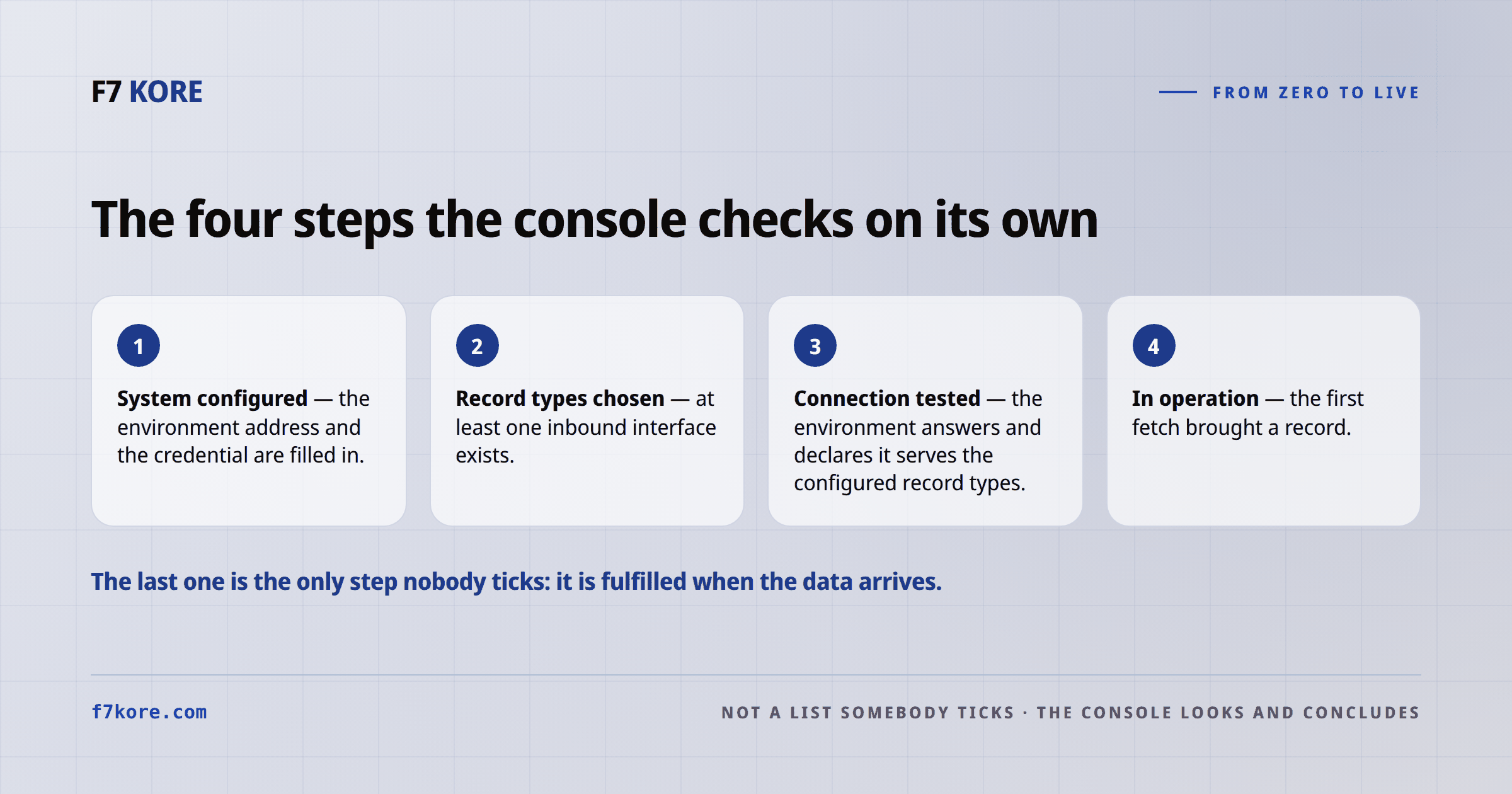
And because connecting a system follows a script. The rollout moves through four steps the console checks on its own: system configured, record types chosen, connection tested, in operation. The last one is the only step nobody ticks — it is fulfilled when the data arrives. And systems are connected one at a time: each one comes in on top of the record, the scoring rule and the panel the previous one left standing.
Configuring the integration and watching it run is F7’s job, in one place — and F7 builds and maintains the integration environment during rollout. What defines that environment is a contract of behavior, not a tool: that is why it fits any server, and an integration partner or your own IT team can take it over whenever your company wants, without touching the core. Your team keeps the integration panel inside F7 KORE: monitor, operate and decide on the data, every day. Scattered configuration is how large integrations rot, which is why it does not scatter.
Underneath all of it is InterSystems IRIS, the data platform F7 KORE is built on — the database behind critical systems in finance and healthcare, with integration in the same core where the data lives. Integration is not a layer we added to the product. It is where the product comes from.
What this unlocks
The revenue report counts one customer. The campaign sends one e-mail. The credit analysis sees the whole history. Whoever registers customers keeps registering them in the system they always used — it is not one more system, and nobody operates it. And everything the platform does about that customer — the record, the task, the form — starts from a single entry. That is the connectivity the new yardstick for buying process software puts among the mandatory capabilities — and it is what sustains auditable operational execution: every action the platform takes starts from the right record and leaves a trace.
There is also what F7 KORE does not do, on purpose. It does not fix the records in your systems: it unifies the reading, and shows that the two sides disagree — which is the useful information. Returning the unified record to a system is possible, is an explicit configuration choice, and is not the default behavior. And it does not delete a record whose last source died: it stays orphaned, with the last known value, until someone decides.
The question that closes a rollout
If the integration stops at three in the morning tomorrow, will your company know it stopped, what stopped, and who to call — reading its own screen, without depending on anyone?
It is the question we close every rollout with, and the one we suggest asking any integration vendor. Us included.
On the silos that are born when every department builds its own assistant, read the next silo in your plant talks back. On the yardstick that now demands connectivity from any process platform, from BPM to BOAT.
F7 KORE is built by F7 KORE SOFTWARE LTDA, an InterSystems partner, in real operations and regulated environments.
Bring the list of systems your company runs and how many customers each one says you have. The conversation starts there. Talk to us.