From BPM to BOAT: the yardstick for buying process technology changed its question
Gartner retired the BPM quadrant in 2021, and it came back in October 2025 under a different name. The new definition demands something the old ones never asked for.
September 14, 2026 · F7 KORE · Applied AI · Manufacturing · Processes
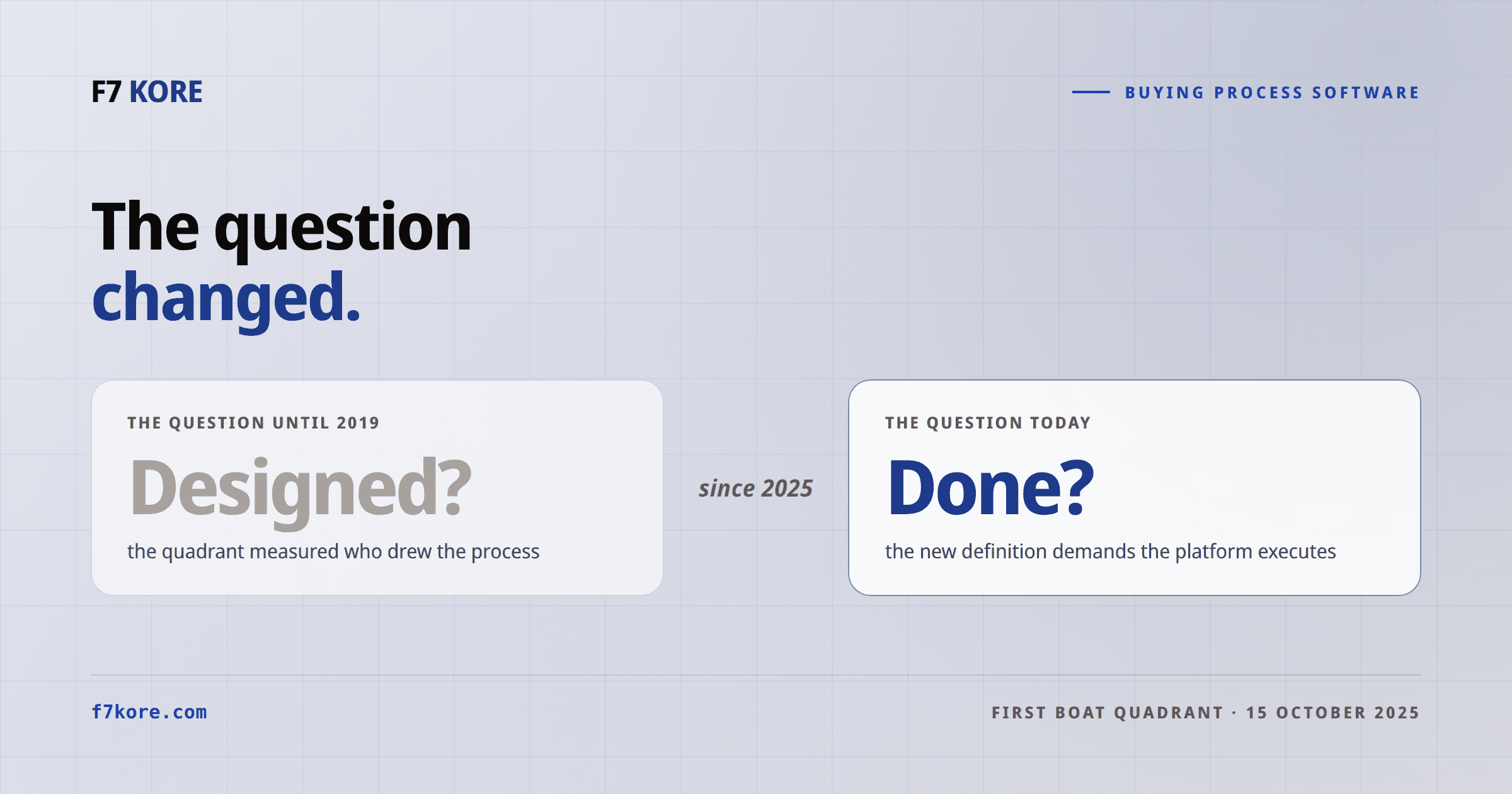
Gartner retired the BPM quadrant in 2021. In October 2025 it came back under a different name and a far broader scope: BOAT — Business Orchestration and Automation Technologies, with around twenty vendors assessed.
This is not acronym fetishism. The change of name changed the question a buyer has to ask a vendor. And it is the question, not the ranking, that matters to a buyer here: the yardstick is public, and it works on any vendor that walks into your room. Us included.
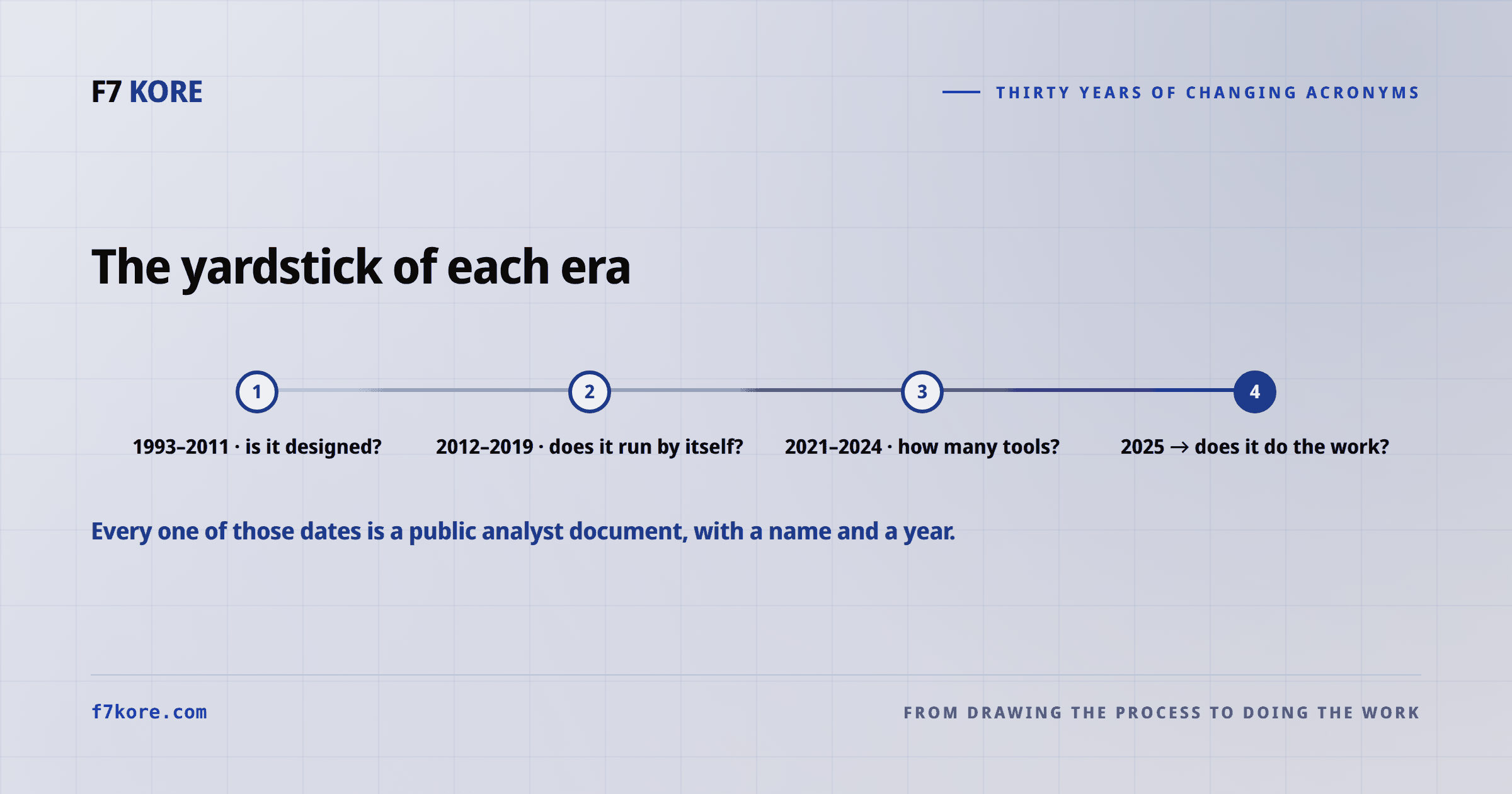
Thirty years of changing acronyms
1993 to 2011 · The Drawing Era “Is your process drawn in standard notation?”
2012 to 2019 · The “Intelligent” BPM Era “Does your flow run by itself inside the system?”
2021 to 2024 · The Fragmentation Era “How many separate tools — task automation, no-code development, process mining — will you have to stitch together to cover the process?”
2025 onward · The Orchestration Era “Does the platform execute and orchestrate the work end to end?”
The 4 mandatory capabilities
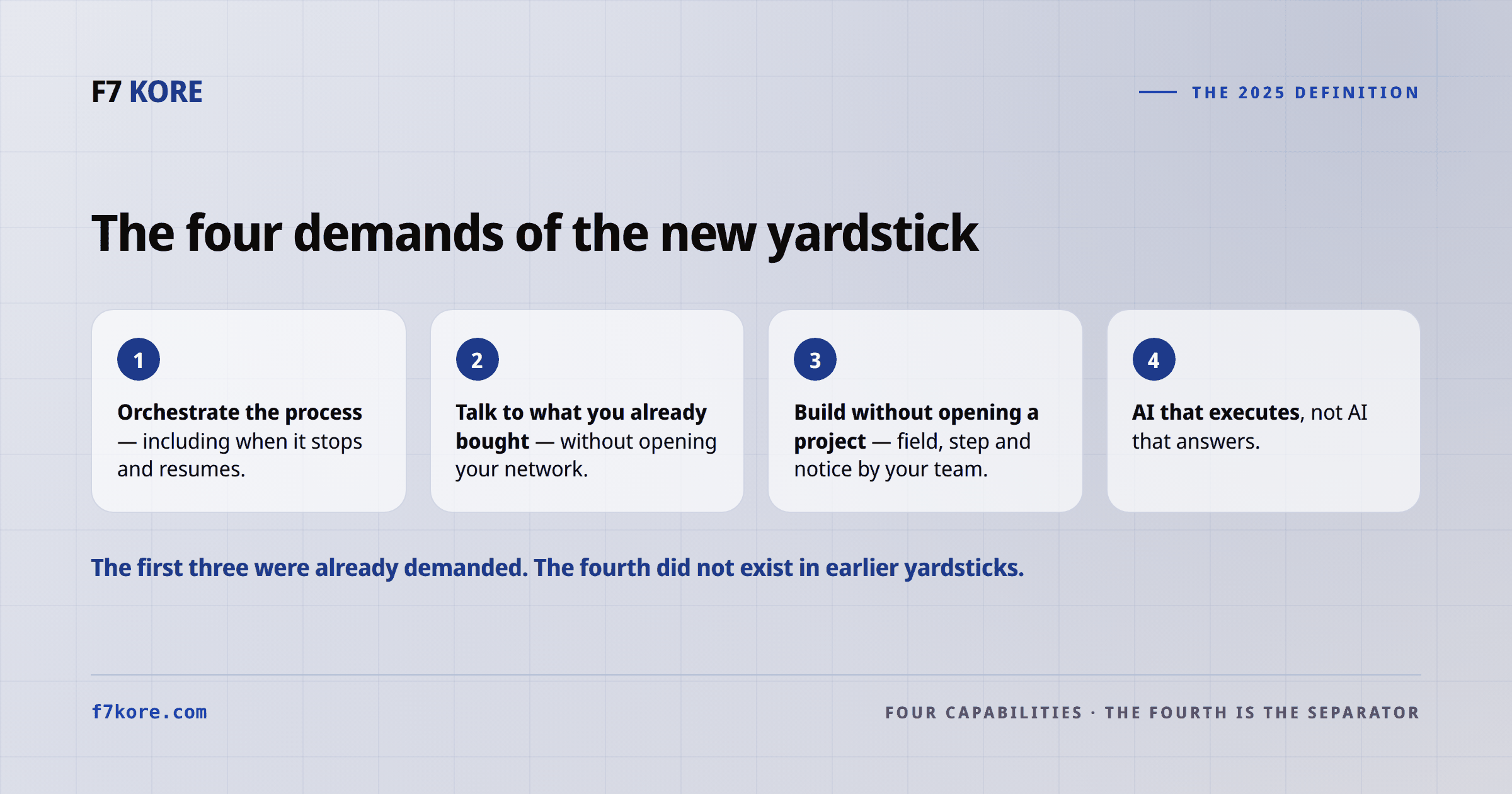
The yardstick got harder. The BOAT definition demands four capabilities of any vendor.
1. Real orchestration
An industrial process does not run in 3 seconds. It waits for the shift to turn over, the supplier to reply, the lab result to come back or the manager to approve. Orchestrating means holding the state of the operation across days and resuming exactly where it left off if something fails along the way.
2. Enterprise connectivity
Reading and writing in your ERP, MES or WMS — whoever the vendor is — without requiring your corporate network to be exposed and opened to the internet.
3. Agility without endless projects
If every simple change, such as adding a field to a form, takes a budget line and an IT queue, the real process migrates to spreadsheets and personal messaging apps. Where nobody audits anything.
4. Agentic automation
AI that executes steps, not AI that merely answers questions. It is the only one of the four you cannot verify in a contract — only on screen, with your data, in your process.
Why the 4th demand changed the game
An AI assistant that merely answers hands the work back to the human. The person still has to open the ERP, type the information in, attach the evidence, notify whoever is next in line and make sure there is a record for the auditor. Out of 6 steps, 5 stay manual.
That explains a number that has been going around: ninety-five percent of generative AI pilots delivered no return at all, according to MIT, in The GenAI Divide, 2025 — and the argument does not depend on the number being 95% or 70%. We have written about why that happens, and the model is not the reason.
What actually transforms the operation is AI that performs the step: fills the form from the operator’s voice note, opens the work order, attaches the evidence, notifies everyone involved and writes an unalterable record — operating strictly within the permissions of whoever triggered it, with the person checking and deciding.
That is why “we have AI” stopped being an answer to anything.
The bill that made the category change its name
Covering a process end to end took four or five products: a flow engine, a task automation tool, document reading, an integration tool and an AI layer.
And the bill is not the sum of the licenses. It is the integration between them, which nobody sells and everybody pays for: five contracts and renewals, five permission models to keep current, five audit trails in different places — and one question left without an owner. Which of the five systems holds the proof?
When the document, the task, the conversation and the indicator are born in the same place, integration stops being a project and becomes a consequence. That is what the word orchestration carries in the new definition.
Separate commodities from differentiators
Before evaluating any software, separate the basics from the essentials.
Commodity — any serious system delivers these: forms on a tablet, required fields, numeric ranges, barcode scanning, two-step approval and indicator dashboards.
A real differentiator: audio, photos and documents becoming structured records; processes that span days and recover from failures; data kept inside your own environment; real identification of time and cost bottlenecks, taken from what actually happened; and an auditable evidence trail with author, timestamp and version.
The first list is nobody’s shortcoming — it is the industry floor, and it is good that it exists. It is just not a reason to change platforms.
9 questions to bring to the vendor meeting
Use this checklist on any platform, ours included.
- Persistence. If the process waits 3 days for a lab result and the server restarts in the middle, what happens to the state of the operation?
- Security. What has to be opened in my network to connect to my ERP? Who holds the credential?
- Autonomy. To add a new field to a form tomorrow, does it depend on my team or on a quote and a ticket from you?
- Action. Does your AI execute any step in the system, or does it only answer questions? Show me an action being performed.
- Governance. When the AI acts, whose permissions does it use? Show me what it cannot do for an ordinary operator.
- Auditability. Where is it recorded that the AI took that action? Can I export it for an audit?
- Usability. Can the operator record by voice and photo, in their own words, with no complex training?
- Real bottlenecks. After 3 months, does the tool show me where work got stuck based on reality, or on the flowchart idealized on paper?
- Fragmentation. How many contracts, permission models and separate audit trails does this solution leave me to administer?
Rule of thumb: if the answer to the 9th comes back as a number greater than one, you are not buying an orchestration platform — you are buying the integration project the platform was supposed to have solved.
F7 KORE brings documents, forms, tasks, conversations, meetings, notifications, indicators, compliance and integration together on a single engine — with AI executing within the permissions of whoever triggers it and every action recorded with author, timestamp and version. The company behind it has automated industrial processes for over a decade, in real operations and regulated environments.
The nine questions above fit in one meeting and change the conversation. If you want to walk through them with someone alongside — talk to us.